Packages
Supply Chain · Inventory
Packages
A package is a physical container holding one or more products. Packages can also be used to store items in bulk.
Packages are commonly used for the following purposes:
Shipping to customers: configure package types to align with shipping carriers’ size and weight requirements, streamlining the packing process, and ensuring compliance with carrier shipping specifications.
Storing items in bulk.
Package Use is a field on the package type form in Odoo that is only visible by enabling the Batch, Wave & Cluster Transfers and Packages features ().
By default, the Package Use field on a package type form is set to Disposable Box. Only change this field to Reusable Box when configuring packages for cluster pickings.
Package Type is a feature most often used for calculating shipping cost, based on real shipping weight. Create package types to include the weight of the package itself (e.g. boxes, pallets, other shipping containers) in shipping cost calculations.
Note
While packages are commonly used in the three-step delivery route, they can be used in any workflow involving products tracked by quantity, lots, or serial numbers.
Configuration
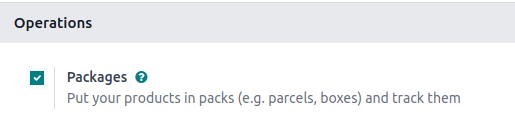
To use packages, first go to . Under the Operations heading, activate the Packages feature. Then, click Save.
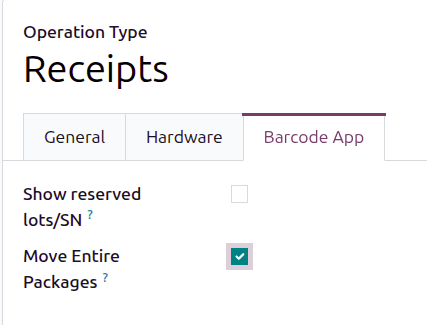
When moving packages internally, the Move Entire Packages feature can be enabled on an operation type to update a package’s contained item’s location upon updating the package’s location.
To do that, go to and select the desired operation this feature will apply to (may have to set it for multiple).
Open the Barcode App tab, then select the Move Entire Packages checkbox.
Pack items
Products can be added to packages in any transfer by:
Clicking each Details link on the product line.
Using the Put in Pack button to place everything in the transfer into a package.
Details
On any warehouse transfer (e.g. receipt, delivery order), add a product to a package by clicking the Details link in the Operations tab.
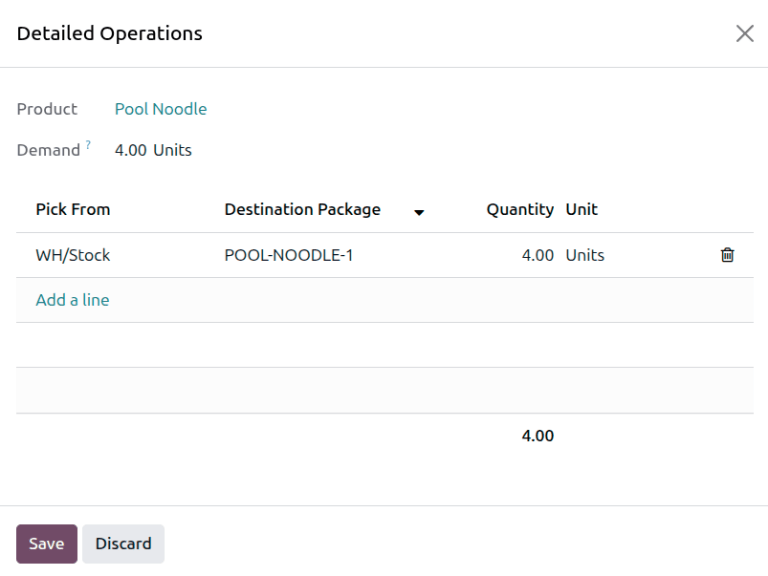
Doing so opens the Detailed Operations pop-up window for the Product.
To put the Product in a package, assign the product to a Destination Package. Split into multiple packages by clicking Add a line. Select an existing package, or create a new one by typing the name of the new package, then select Create.
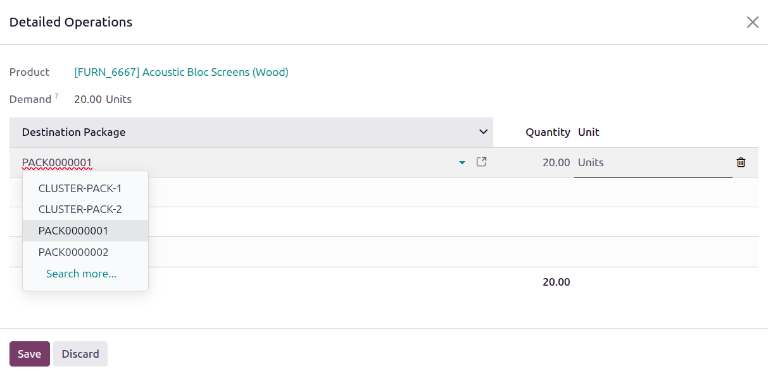
20 units of Acoustic Bloc Screen are placed in PACK0000001.
Then, specify the quantity of items to go into the package in the Quantity column. Repeat the above steps to place the Product in different packages. Once finished, click Save to close the window.
Put in pack
Alternatively, click the Put in Pack button on any warehouse transfer to create a new package, and place all the items in the transfer in that newly-created package.
Important
The Put in Pack button appears on receipts, delivery orders, and other transfer forms with the Packages feature enabled in .
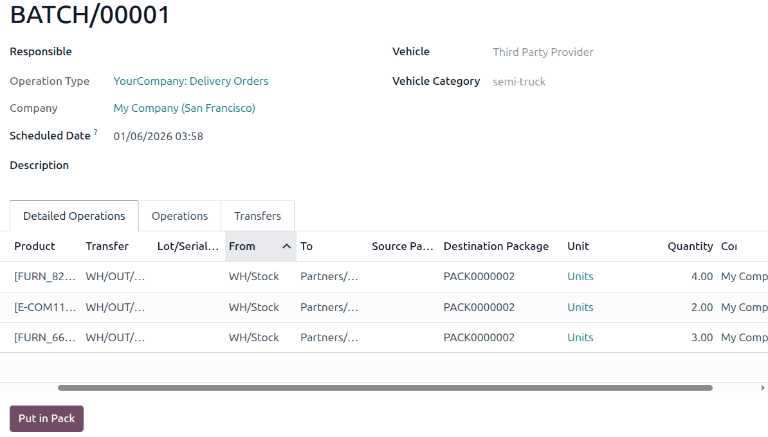
In batch transfer BATCH/00001, the Put in Pack button was clicked to create a new
package, PACK0000002, and assign all items to it in the Destination Package field.
Create package types
Create package types by navigating to , in order to set custom dimensions and weight limits. This feature is mainly used to calculate package weights for shipping costs.
See also
On the Package Types list, clicking New opens a blank package type form.
Define the Package Type name.
Configuration tab
The following fields are available in the Configuration tab of a package type form:
Barcode: Define a barcode to identify the package type from a scan.
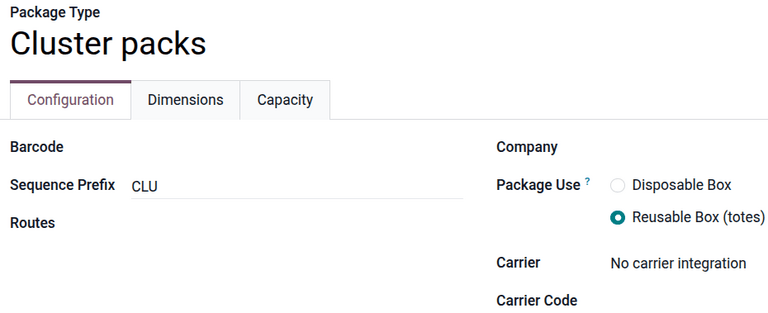
Sequence prefix: Specify the prefix to use when creating new packages of this type.
Example
Stealthy Wood wants to create a package type for cluster packs. They specify
CLUas the sequence prefix.Routes: Specify the routes for which this package type can be used.
Company: Specify a company to make the package type available only at the selected company. Leave the field blank if it is available at all companies.
Package Use: Choose Reusable Box (totes) for packages used for moving products within the warehouse. Choose Disposable Box for packages used to ship products to customers.
Carrier: Specify the intended shipping carrier for this package type.
Carrier Code: Define a code that is linked to the package type.
Dimensions tab
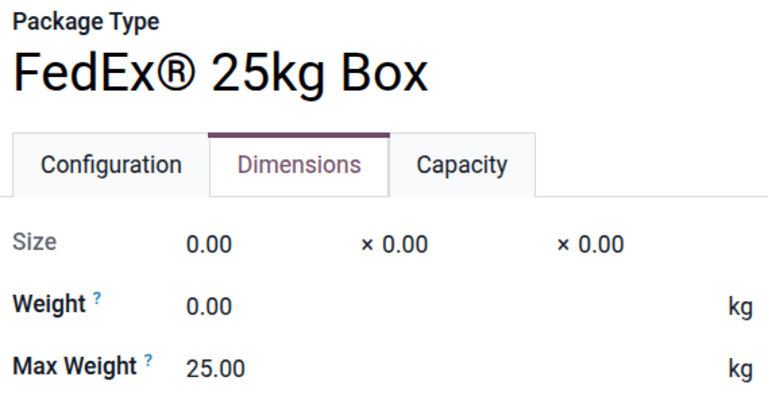
Use the Dimensions tab to specify package dimensions:
Size: Define the dimensions of the package in millimeters (mm). The fields, from left to right, define the Length, Width, and Height.
Weight: Define the weight of an empty package (e.g. an empty box, pallet).
Note
Odoo calculates the package’s weight by adding the weight of the empty package plus the weight of the items, which can be found in the Weight field in the Inventory tab of each product form.
Max Weight: Specify the maximum shipping weight allowed in the package.
Capacity tab
This tab can only be configured if Multi-Step Routes is also enabled in .
Select or create a Storage Category and Quantity by clicking Add a line.
See also
Cluster packages
To use cluster packages, first navigate to , and activate the Batch, Wave & Cluster Transfers feature, located in the Operations section.
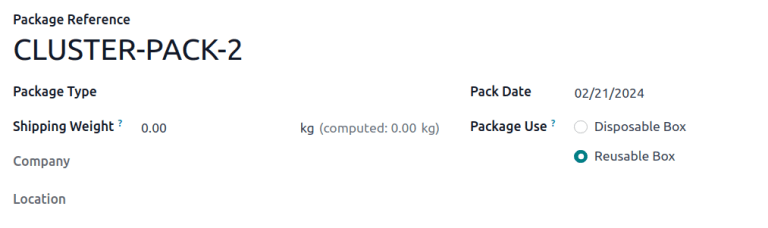
Add new packages by going to . Then, click New, or select an existing package. Doing so opens the package form, which contains the following fields:
Package Reference (required): Define the name of the package.
Package Type: Specify the package type to use.
Note
Setting a Package Type is unnecessary for configuring packages for cluster pickings.
Location: Define the current location of the package.
Container: If the package is contained within another package, define the container package.
Shipping Weight: Used to input the weight of the package after measuring it on a scale.
Company: The company that can use this package is defined.
Pack Date: Specify the date the package was created.
Below the package definition fields is the Content section. Use this field to learn more about the contents of the package.
See also
View packages
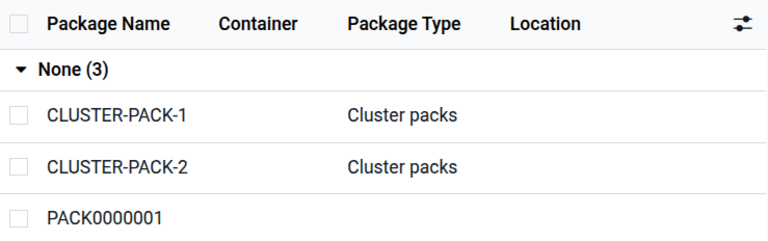
To view all packages, go to . By default, packages are shown in list view.
Adapted from the Odoo 19.0 User Documentation for DigitsCode customer support. © Odoo S.A. DigitsCode capabilities remain in the DigitsCode Capabilities category.